
Explore Legal Topics
Browse our library of legal topics written in plain language. Find the area that matters to you and start learning.

Constitutional Law
What It Is Constitutional Law is about the rights and rules written in constitutions (the highest laws of a country or state) and making sure all other laws follow those rules.
The Main Ideas 1. Rights We All Have The U.S. Constitution’s Bill of Rights (first 10 amendments) guarantees basic freedoms: Freedom of speech – You can say what you think Right to a fair trial – If accused of a crime, you get your day in court Freedom from discrimination – You can’t be treated unfairly based on who you are
2. State Constitutions Each state has its own constitution that: Gives citizens the same federal rights Often adds extra protections for state residents Can never take away federal rights Example: Your state might guarantee the right to clean water (extra protection), but it can’t remove your federal right to free speech.
3. How Government Works Constitutions divide government into three branches: Legislative – Makes laws (Congress/Parliament) Executive – Enforces laws (President/Governor) Judicial – Interprets laws (Courts) Constitutional lawyers handle disputes when these branches conflict.
In Practice If a law seems to violate the Constitution, courts step in to decide if it’s legal. This protects citizens from unfair government actions.

Criminal Law
Criminal law defines crimes and the punishments for committing them. A crime is an action—or a failure to act when the law requires action—that violates a criminal law.
The government brings a criminal case against the accused person. Being arrested or charged does not mean someone is guilty: the government must prove the crime beyond a reasonable doubt.
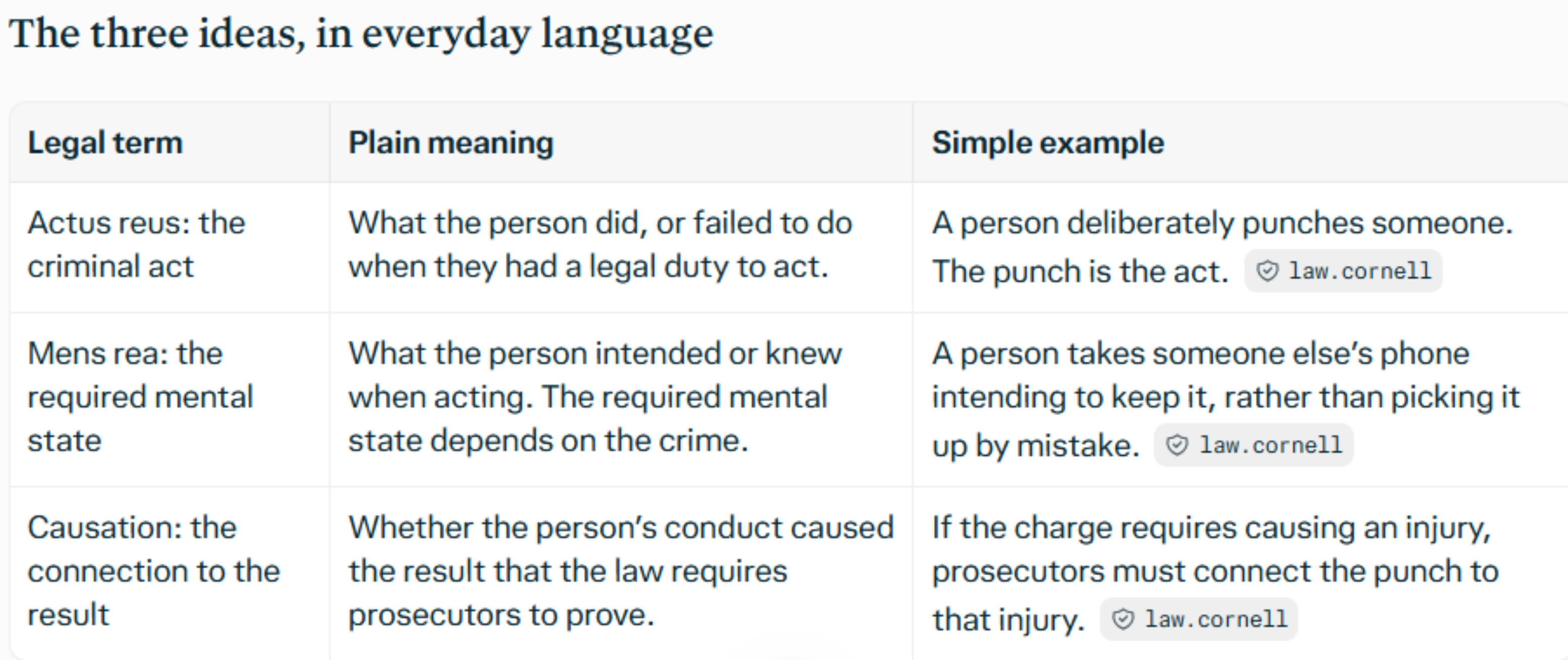
One important clarification: these are useful starting points, not an identical checklist for every crime. The law defining the particular offense determines exactly what prosecutors must prove. Causation matters when the offense requires a particular result; not every offense requires proof of actual injury. Example: taking the wrong phone Imagine two people take a phone from a café table: One takes it knowing it belongs to someone else and intending to keep it. The other takes it honestly believing it is their own. The physical action looks the same, but the person’s state of mind is different. That difference matters when the offense requires an intent to steal. Prosecutors must prove the required intent, not just that someone picked up the phone. Example: failing to act An “omission” simply means not doing something. But failing to help is not automatically a crime: criminal responsibility for an omission generally requires a legal duty to act. For example, a parent’s failure to provide necessary care for a child may qualify because parents have legal responsibilities toward their children.

Civil Law
Civil law has two meanings. First, it covers non-criminal rights and disputes between people or organizations, such as contracts, property, and family matters. For example, suing a builder for unfinished work is a civil case. Second, it means a legal system based mainly on written codes, with roots in Roman law. In this system, a judge resolves a dispute primarily by applying the written rules, rather than relying mainly on earlier court decisions. Example: You pay a builder to repair your house, but they do not finish the work. You sue to get your money back. This is a civil-law dispute because it concerns a contract, not a criminal prosecution

Family Law
Family law deals with legal matters involving families, such as marriage, divorce, child custody, adoption, and protection from domestic violence. In the United States, these rules mostly come from state law, so they differ from state to state. Many states have special courts for family matters.law.cornell Simple examples • Divorce: A married couple asks a court to legally end their marriage.law.cornell • Child custody: Parents separate, and a court decides arrangements for their child based on the child’s best interests.law.cornell • Adoption: A person goes through the legal process to become a child’s parent.law.cornell • Domestic violence: A person seeks legal protection from an abusive family member or partner.

Business Law
Business law is the set of rules for starting, running, and closing a business. It covers matters such as contracts, debts, taxes, employee rights, and customer protection. It applies to large companies and people running a business on their own. Simple examples • Contracts: A bakery agrees to buy flour from a supplier. Both sides must meet the terms of their legally binding agreement. • Business debts: A shop borrows money, and the law governs its repayment obligations and the lender’s rights. • Customer protection: Laws protect customers against unfair business practices. Its main purpose is to make business dealings fairer and clearer by setting out everyone’s rights and responsibilities.

Employment Law
Employment law sets the rules for how employers and workers must treat each other. It protects workers’ rights to legally required pay, workplace safety, and freedom from unlawful discrimination. Simple examples Pay: An employer must pay eligible workers at least the applicable minimum wage and provide required overtime pay. Safety: A factory must follow safety rules to protect workers from serious hazards. Equal treatment: An employer cannot reject a job applicant because of their race or religion when covered by anti-discrimination laws. In the United States, federal and state agencies enforce these rules. The Department of Labor handles many pay and safety laws, while the Equal Employment Opportunity Commission handles many workplace discrimination laws

Immigration Law
Immigration means moving to another country to live there, rather than visiting temporarily. Immigration law sets the rules about who may enter and stay, and under what conditions. Simple examples Authorized immigration: A person receives permission to move to another country permanently. Unlawful immigration: A person moves to or remains in a country without the required legal permission. Temporary travel: A person visits for a vacation or a short study program and plans to return home. Under this definition, that is not immigration—but immigration laws still govern their entry and stay.

Environmental Law
Environmental law is the set of rules that protects nature and people’s health. It helps control pollution, conserve natural resources, and ensure those resources are used responsibly.
Simple examples • Clean air: A factory must follow limits on the pollution it releases into the air.• Clean water: A business must follow permit rules before releasing wastewater into a river.e • Safe waste disposal: A company must handle and dispose of hazardous waste properly.
In the United States, the Environmental Protection Agency (EPA), along with other government agencies, helps enforce environmental rules.

International Law
Understand how law works beyond borders — treaties, human rights, international courts, and the rules that govern relations between nations.

Intellectual Property
Learn how the law protects creative and inventive work — copyrights, trademarks, patents, and trade secrets.

Cyber Law
Cyber laws are the legal frameworks and regulations that govern activities on the internet and digital devices. They address issues such as cybercrime, data protection, privacy, intellectual property, and electronic transactions. Essentially, cyber laws provide the rules for using technology responsibly and legally, ensuring that both individuals and organizations follow protocols that protect rights and maintain order in the digital environment.

Juvenile Law
In criminal law, a juvenile is an adolescent who is not old enough to take responsibility for a crime they are accused of, so they might not be seen in a traditional court, but by a juvenile court. A juvenile delinquent is an adolescent who has been found guilty of a crime. At the federal level, the age limitation is under 18, but committing a serious crime or repeated offenses might cause a juvenile to be tried as an adult under criminal law according to 18 U.S. Code § 5031. The juvenile is also protected specially by the law, for example, the juvenile shall not be detained for longer than a reasonable period of time before a magistrate judge; the arresting officer shall immediately advise the juvenile’s legal right and notify their parents and the attorney general, according to 18 U.S. Code § 5033.

Election Law
Explore the rules that govern elections — voting rights, campaign finance, redistricting, and the legal framework of democracy.

Consumer Protection
Know your rights as a consumer — fraud, deceptive practices, product liability, and the agencies that protect buyers.
Can't find what you're looking for?
We're always adding new topics. Send us a suggestion and we'll work on covering it.